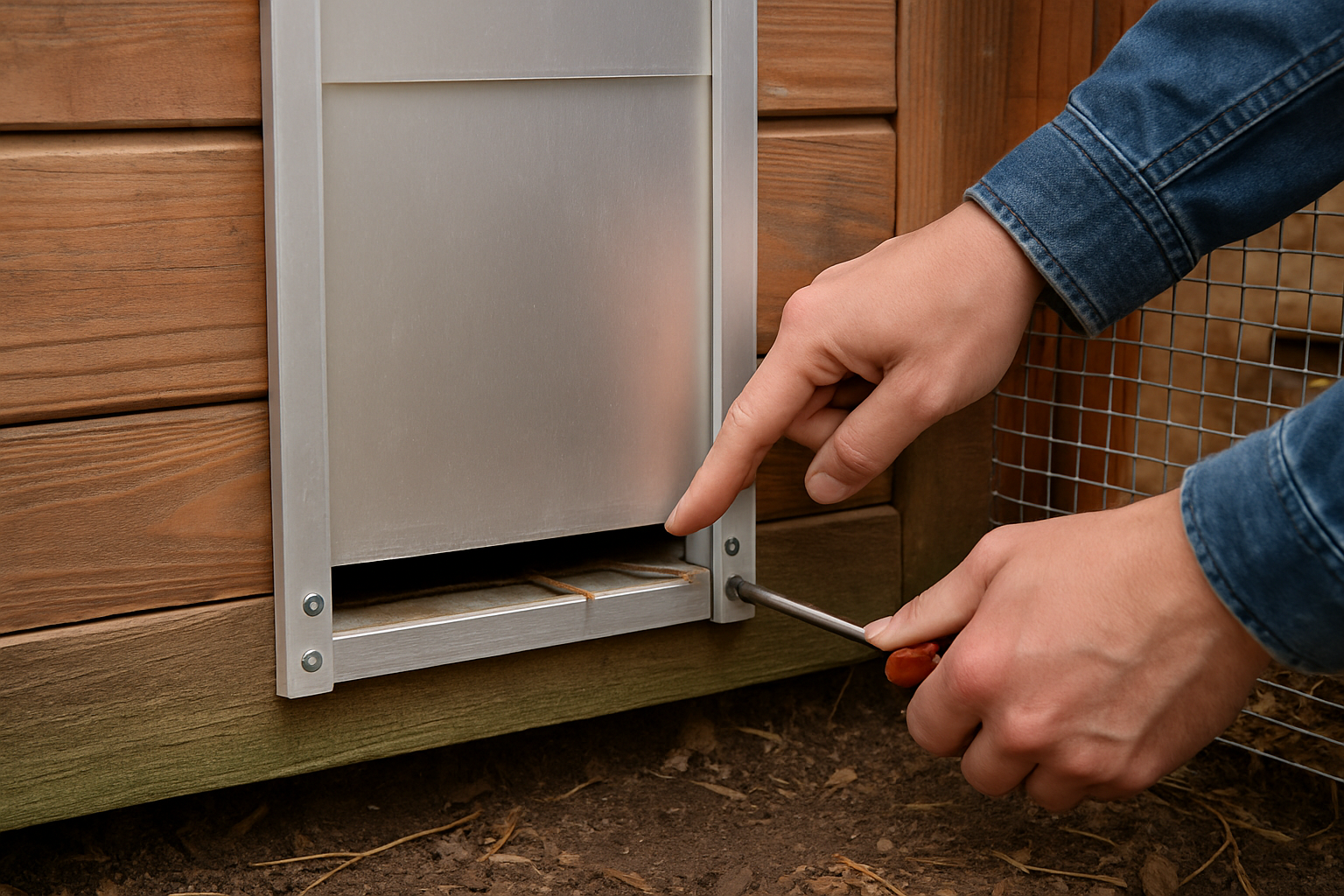
When backyard flock owners invest in a premium automatic chicken coop door, their minds often focus on large, headline-grabbing predators: raccoons prying at the panels, foxes waiting in the brush, or coyotes attempting to tear down the frame. Consequently, manufacturers build doors with rigid aluminum plates, gear-locks, and self-locking wings designed to withstand brute, heavy-handed force.
However, there is an entire class of microscopic and highly agile predators that do not rely on brute force. Instead, they exploit the tiniest mechanical tolerances of an automated setup.
Weasels (*Mustela nivalis*), American mink (*Neogale vison*), and Norway rats (*Rattus norvegicus*) are notorious for their ability to compress their skeletal structures and squeeze through unimaginably small openings. If your automatic door leaves even a fraction of an inch of a gap at the base when closed, or if the side tracks are slightly recessed, these sleek, bloodthirsty intruders will slip inside.
This comprehensive guide breaks down the anatomy of small-predator intrusions, analyzes how they exploit automatic door tolerances, and provides exact tactical installation protocols to make the base of your automated door 100% impervious to weasels, mink, and rodents.
🐹 1. The Small-Predator Profile: How Much Space Do They Need?
To secure the bottom of an automatic door, you must understand the exact physical limits of the animals trying to breach it. A good rule of thumb on the homestead is: if an egg can fit through a gap, a weasel can too.
🕳️ 2. The Vulnerability: Track Deflection and Substrate Gaps
- Least Weasel: Can fit through a hole exactly 0.5 inches (12-13 mm) in diameter.
- Norway Rat: Needs roughly 0.5 to 0.75 inches of clearance to squeeze its skull through.
- Mink: Requires a gap of approximately 1 to 1.25 inches.
Vulnerability A: Track Deflection (The Bottom Flex)
The least weasel is the smallest mammalian carnivore on earth. They possess incredibly long, cylindrical bodies and flexible rib cages. Unlike raccoons, which hunt to eat, weasels are driven by a high-metabolic predatory reflex. If they slip into a coop, they will often kill every single bird in a bloody frenzy, dragging away only a fraction of their haul.
Vulnerability B: Uneven Substrate Gaps
Mink are larger, semi-aquatic cousins of the weasel. They have massive jaw strength and can easily chew through wood or vinyl if they find a soft starting edge at the base of a door track.
🛠️ 3. Physical Upgrades to Secure the Door Base
While rats rarely attack full-grown chickens, they will kill young chicks, eat eggs, steal feed, and chew through the delicate wiring or solar lines running to your automatic door controller. More importantly, they use their teeth to widen tiny gaps under door tracks, creating an entry point that a weasel can use the following night.
Step 1: Install a Solid Metal Landing Threshold
Standard automatic doors are designed to slide smoothly up and down a track. To achieve this smooth travel, engineers must leave microscopic clearances between the door panel and the track walls. Small predators exploit these gaps using two primary methods.
Step 2: Recess the Bottom Track with a Sub-Flush Lip
When an automatic door closes, it drops down until it hits the bottom threshold. However, if the door panel is made of thin aluminum or ABS plastic, the very bottom corners can often be forced outward with a bit of leverage.
A weasel or rat will slide its nose into the lower corner where the door panel meets the vertical track. By wedging its skull forward, the animal can cause track deflection—forcing the flexible door panel to bow outward just enough to create a 0.5-inch opening. Once the head is through, the rest of the elongated body follows instantly.
Step 3: Implement Bedding Guards (Deep Litter Shields)
This is the most common installation failure on custom wooden coops. If you mount an automatic door onto raw, uneven wood, or if the door closes directly onto a floor littered with hemp bedding, wood shavings, or accumulated frozen droppings, the door will encounter resistance before it reaches true zero.
Smart doors (like Chickcozy or Omlet) feature anti-pinch safety sensors. If the door hits a hard clump of frozen chicken manure or a thick twig on its way down, it assumes a chicken is underneath, stops its descent, and leaves a small, 0.5-inch gap at the bottom.
To a human, the door looks closed. To a mink or weasel, it is an open invitation.
🔍 4. Regular Maintenance Protocol for Small-Predator Prevention
To completely eliminate small-predator breaches, you must upgrade the physical landing zone where your automatic door terminates its closing cycle.
📊 5. Summary Blueprint for Small-Predator Defense
Never allow an automatic door panel to close directly onto soft wood, soil, or loose bedding. Over time, chickens will scratch at the wood, wearing away a dip directly underneath the door path.
- The Fix: Screw a solid piece of 1-inch aluminum angle iron or a heavy steel plate directly beneath the door opening. The bottom edge of the automatic door must land completely flush against this hard, non-yielding metal surface. Predators cannot scratch or chew a dip into metal, ensuring your bottom seal remains tight year after year.
Step 2: Recess the Bottom Track with a Sub-Flush Lip
If you are building a custom coop or modifying an existing one, the safest configuration is to create a drop-step or "sub-flush lip."
- The Fix: Position your metal threshold so that when the automatic door is fully closed, the bottom 0.5 inches of the door plate drops down *behind* a structural wooden or metal face. This creates an overlapping "maze" joint. A weasel approaching the door from the outside will meet a solid wall of metal or wood, completely blocking it from sliding its snout under the door plate.
Step 3: Implement Bedding Guards (Deep Litter Shields)
If you utilize the deep litter method inside your coop, chickens will constantly kick shavings into the path of the automatic door tracks, causing false sensor trips or propping the door open slightly.
- The Fix: Install a 4-to-6-inch kickboard (bedding guard) directly inside the coop, positioned 2 inches behind the automatic door opening. This structural board keeps the loose bedding material safely contained inside the coop and clear of the door's vertical path, allowing the door to consistently achieve a tight, flush seal against its base.
🔍 4. Regular Maintenance Protocol for Small-Predator Prevention
Because weasels and rats look for the absolute smallest points of failure, maintaining your door base is a weekly necessity during the fall and winter months when small rodents actively seek warm shelters.
- The Track Floss: Once a month, take an old toothbrush or a stiff wire brush and clear out the very bottom of the vertical tracks. Packed dirt, downy feathers, and feed dust accumulate here, preventing the door panel from dropping to its true mechanical limit.
- The Pencil Test: With the automatic door fully closed, attempt to slide a standard wooden pencil under the base or into the bottom corners. A standard pencil is roughly 0.28 inches (7mm) thick. If you can slide the pencil under the door or twist it into a gap, the opening is large enough for a young weasel or rat to exploit. You must adjust your door's calibration or re-level your bottom threshold.
- Inspect Wire Runs: Weasels will follow any line or wire looking for an opening. If you ran solar wires or DC power cables through a hole drilled into your coop wall, ensure that hole is tightly packed with stainless steel wool and sealed with heavy-duty outdoor caulking. Rodents can easily chew through bare wood and foam sealant, but steel wool stops them instantly.
📊 5. Summary Blueprint for Small-Predator Defense
| Threat Factor | Vulnerability Point | Ultimate Tactical Fix |
|---|---|---|
| Least Weasel | Bottom track corners (0.5" gap) | Metal angle iron landing threshold + sub-flush overlap. |
| Norway Rat | Chewing soft wood frames at the base | Armoring the lower 6 inches of the frame with flashing or aluminum tracks. |
| American Mink | Forcing flexible ABS/Aluminum panels | Choosing rigid direct-drive doors or reinforcing the track walls. |
| Frozen Chicken Manure | Propping the door open via safety sensors | Weekly track checks and installing an interior bedding kickboard. |
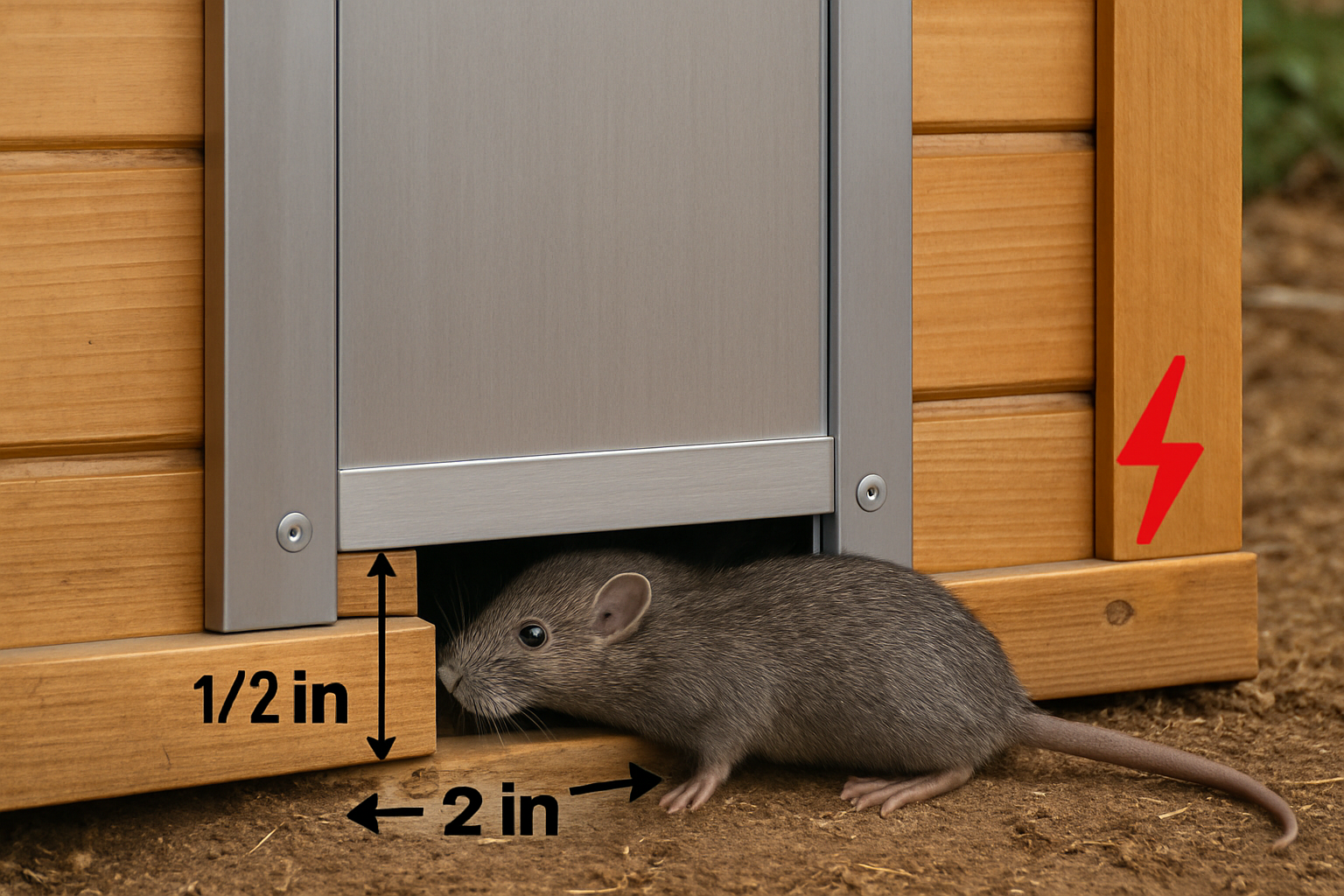
By treating the base of your automatic chicken coop door as a precision engineering seal, you can enjoy all the convenience of automation without ever worrying about small, nocturnal predators sneaking past your defenses.