For those who keep backyard chickens, raccoons pose a significant threat. These creatures are not only hungry but also highly intelligent and strong. Their dexterous paws, similar to human hands, make them adept at manipulating objects. If you're considering an automatic chicken coop door, the pressing question is: Can a raccoon lift it open?
The answer is nuanced. While raccoons can easily bypass certain types of doors, others are nearly impossible for them to defeat. This guide explores raccoon biomechanics, identifies door vulnerabilities, and offers advice on selecting a predator-proof system.
Understanding Raccoon Mechanics
To determine if your coop door can withstand a raccoon, it's crucial to understand their physical capabilities. Raccoons have a unique evolutionary trait: tactile dexterity. Their front paws are equipped with numerous sensory receptors, allowing them to manipulate objects even in complete darkness.
Raccoon Strength and Dexterity
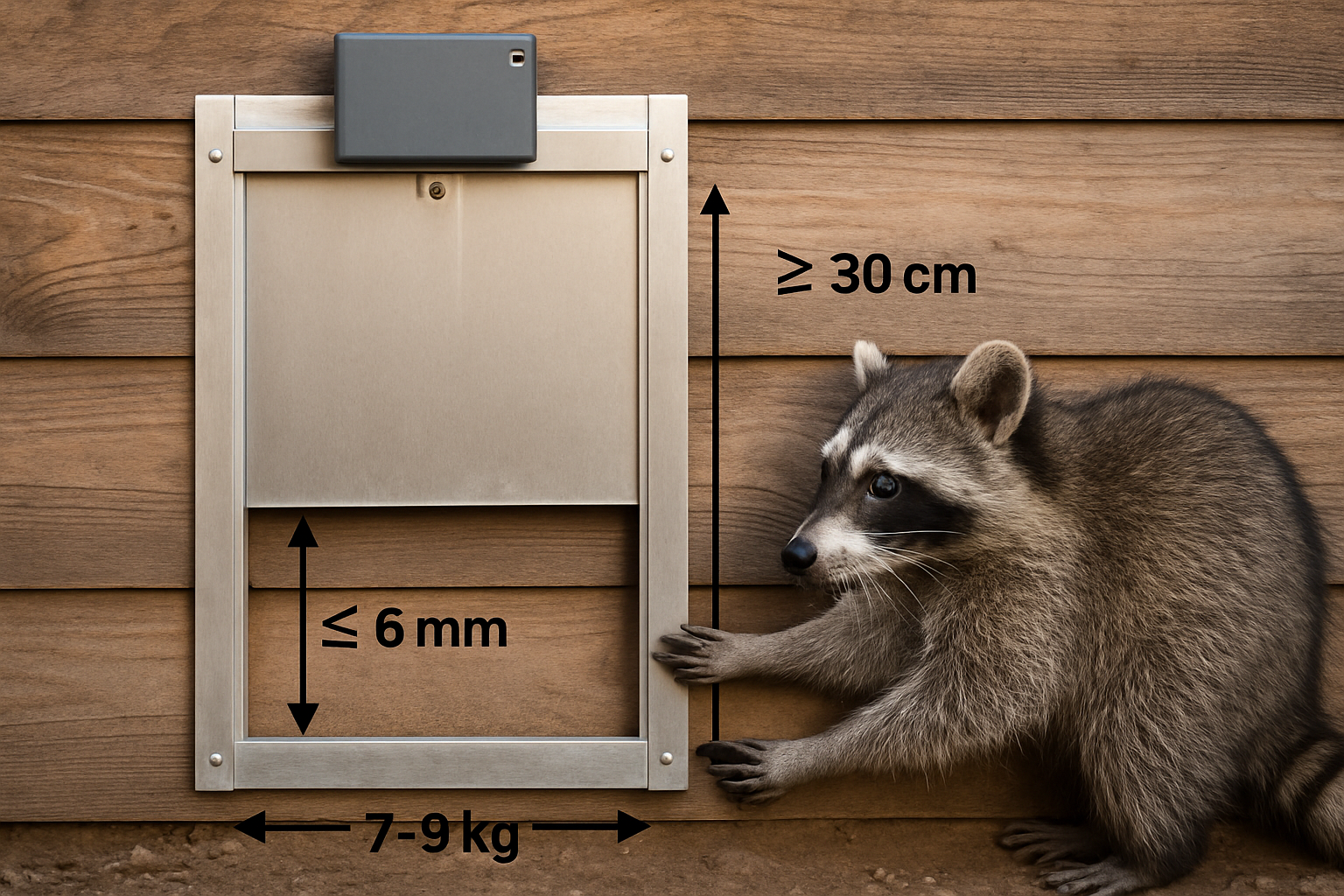
Raccoons typically weigh between 10 to 30 pounds (4.5 to 13.5 kg). They employ two primary methods to breach coop doors:
- Prying Friction: With sharp claws, raccoons can insert their fingers into gaps as small as 0.25 inches (6 mm). They then use their body strength to lift.
- Vertical Lift Power: A healthy raccoon can exert a vertical lifting force of 15 to 20 pounds (7 to 9 kg).
If your door relies solely on its weight to stay closed, it is vulnerable to raccoon attacks.
Comparing Door Mechanisms
The security of an automatic door is not about cost but its internal mechanics. Automatic doors generally fall into two categories:
String-and-Spool Doors: A Weak Link
Many budget-friendly doors use a motorized spool to drop a panel into side tracks. The motor winds a string to lift the door and unwinds to close it, relying on gravity.
- Vulnerability: Once closed, no mechanical force holds the door down. Raccoons can easily lift the panel by prying at the bottom edge, as the string slackens.
Gear-Driven Doors: A Secure Solution
High-end doors, like the Omlet Smart Door, use a gear-driven system. An electric motor connects to a gear that moves along a track.
- Security: The gear teeth mesh tightly with the track, locking the door in place. A raccoon would need immense force to strip the gears, which is beyond their capability.
The Bottom Lip Flap Hazard
Even a heavy metal door can be compromised if not installed correctly. Raccoons search for leverage points, and a door resting on a flat surface can be pried open.
Recessed Channel Installation
To thwart raccoons, ensure your door closes into a recessed channel or behind a raised lip. This setup hides the door's bottom edge, preventing raccoons from getting a grip.
Essential Features for a Raccoon-Proof Door
When selecting an automatic coop door, prioritize these features:
| Feature | Protection Mechanism | Raccoon Deterrent |
|---|---|---|
| Motorized Gear Drive | Uses a rack-and-pinion system instead of strings. | Prevents lifting without breaking gears. |
| Self-Locking Wings | Side tabs snap outward when closed. | Stops horizontal prying. |
| Deep Track Channels | Tracks that cover at least 1 inch of the door edges. | Prevents pulling the door outward. |
Software Vulnerabilities: The Raccoon Loop
Modern doors have safety features to prevent injury, like reversing if they encounter resistance. However, raccoons can exploit this by triggering the sensor as the door closes.
Configuring Your Door
Ensure your door's control box is set to a "strict retry" mode. Quality doors attempt to close three times before locking or sounding an alarm, preventing raccoons from exploiting the safety feature.
Final Recommendation
Can raccoons lift an automatic coop door? If it's a basic, string-operated door, they likely can. However, investing in a gear-driven system with a recessed installation will create a formidable barrier. By combining smart technology with proper installation, you can ensure your flock's safety from raccoon intrusions.