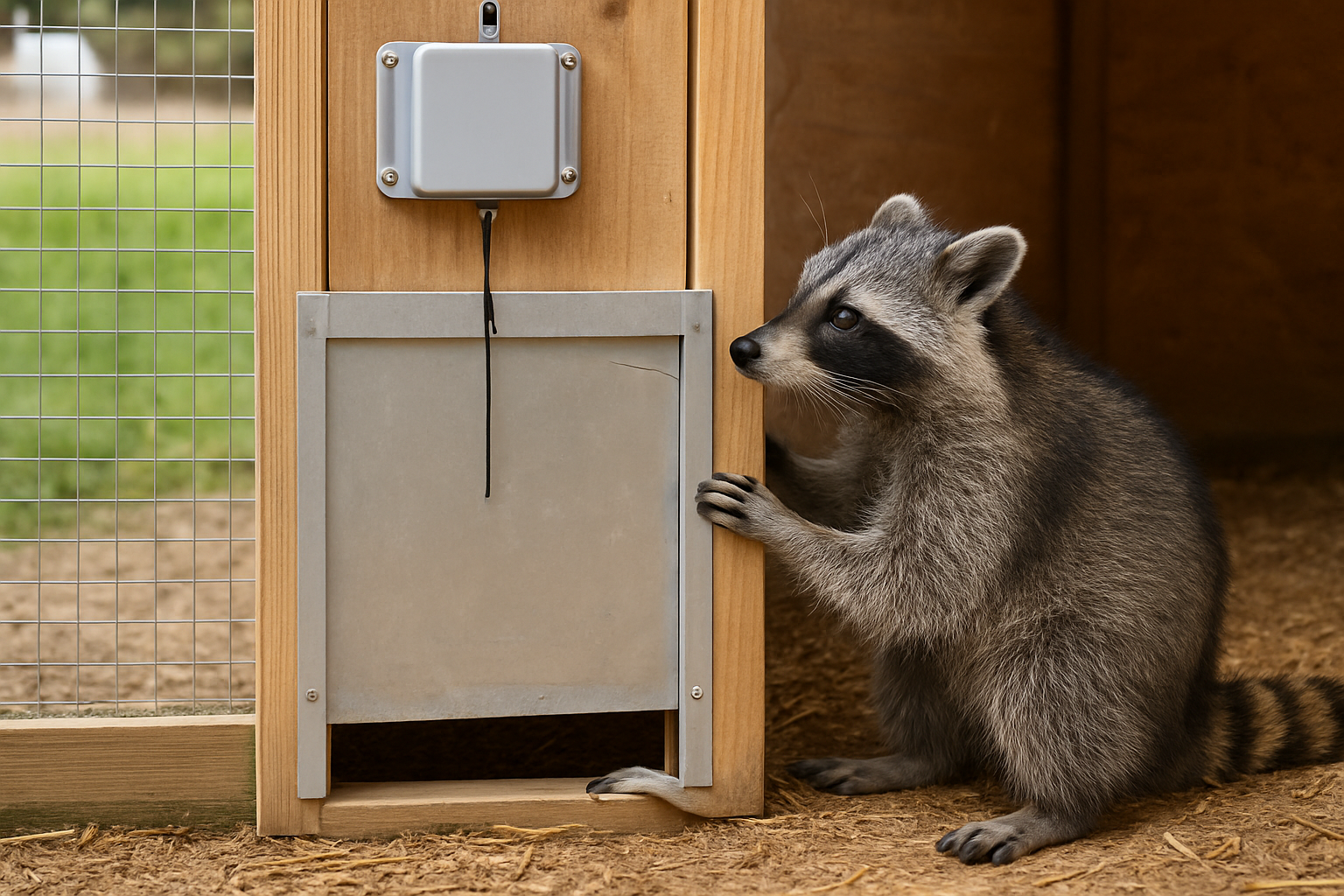
For backyard chicken keepers, raccoons (*Procyon lotor*) are a notorious threat. These clever creatures are not just about brute strength; they possess a unique combination of intelligence and dexterity. With their nimble paws, raccoons can manipulate objects much like humans, making them adept at opening latches, turning knobs, and even unhooking carabiners.
When a raccoon approaches an automated chicken coop in the dead of night, it doesn't attack haphazardly. Instead, it meticulously examines the perimeter for any potential weak points. This raises a important question for those relying on automated systems for flock security: Can a raccoon physically lift a closed automatic coop door?
The answer is yes, particularly if you're using a standard "gravity-drop" door. However, understanding raccoon capabilities and door mechanics can help you design a system that is entirely raccoon-proof. Let's the physics, mechanics, and protective measures you can take.
🦝 1. The Physics of a Raccoon Attack: Leverage and Lift Capacity
To comprehend how raccoons might breach an automatic door, it's essential to consider their physical attributes.
- Lifting Strength: Adult raccoons, weighing between 15 to 25 pounds, can exert a vertical lifting force of 10 to 15 pounds with their front limbs. Motivated by the scent or sound of chickens, they can brace themselves against the ground or coop wall to enhance their leverage.
- Dexterous Paws: Although raccoons lack opposable thumbs, their five long digits are highly sensitive, thanks to a dense network of tactile nerve receptors. This allows them to insert their fingers into gaps as small as 0.25 inches beneath a door, curve their claws, and pull upward effectively.
❌ 2. Why "Gravity-Drop" Doors Fail the Raccoon Test
Most budget-friendly automatic coop doors use a string-and-pulley lift mechanism, commonly known as a gravity gate.
🛡️ 3. The Solution: Mechanical Locks and Rigid Drives
In a gravity-drop system, a motorized spindle box winds up a cord to open the door and reverses to let the door slide down to close. When shut, the cord goes slack, leaving the door's weight as the only barrier.
- Door Weight: Typically made of lightweight materials like aluminum or ABS plastic, these doors weigh between 1.5 to 3 pounds. A raccoon can easily lift this weight, causing the lifting string to slacken further, creating a gap for entry.
Option A: The Automatic Wing Lock
To thwart raccoon attempts, consider doors with active mechanical locking or a non-back-drivable drive train. Here are three designs that effectively prevent raccoon interference:
Option B: The Linear Worm-Drive Screw
Brands like ChickenGuard offer doors with deadbolts that deploy when the lifting string slackens. As the door reaches the bottom, the lifting bracket's hub collapses slightly, activating locking wings that slide into side track slots. This design transfers any upward force sideways, preventing the door from moving until the motor retracts the wings.
Option C: The Horizontal Scroll Door
Manufacturers like Coop Tender use a worm drive, replacing cords with a steel threaded rod. Worm-gear assemblies are non-back-drivable, meaning physical force on the door cannot rotate the screw backward. Even if a raccoon applies its full weight, the door remains immovable.
📋 4. The 3-Step "Raccoon Proof" Field Test
Chickcozy offers doors that open horizontally, eliminating the bottom edge leverage point. These doors lock into a gear track, preventing sideways prying.
📊 Summary: Predator Defense Breakdown
To assess your current door's resistance to raccoons, conduct this simple three-step test:
- The Pry Test: Use a flat metal tool to gently pry the door's bottom lip. If it lifts easily, a raccoon can do the same. Consider upgrading.
- The Track Flex Inspection: Pull the door's bottom corners outward. If it flexes enough to pop out of its tracks, a raccoon can exploit this weakness.
- The Calibration Check: Inspect the bottom track for debris. If the door's safety sensor hits an obstruction, it may leave a gap, inviting raccoon entry.
📊 Summary: Predator Defense Breakdown
| Door Drive System | Lift Resistance | Raccoon Defense Rating | Action Required |
|---|---|---|---|
| Basic Cord & Pulley | Relies on panel weight (1–3 lbs). | 🔴 Highly Vulnerable | Replace or add a manual exterior slide bolt at night. |
| Horizontal Roll/Scroll | No bottom lip; gear-locked tracks. | 🟡 Very Secure | Keep center tracks clear of dirt and debris. |
| Mechanical Wing Lock | Dual horizontal deadbolts into tracks. | 🟢 Excellent Defense | Regularly clean the lower track slots. |
| Steel Worm-Drive | Absolute lock; non-back-drivable screw. | 🟢 Impervious Fortress | Zero additions needed; completely raccoon-proof. |

By understanding raccoon behavior and leveraging advanced door mechanics, you can ensure your chickens remain safe and secure. Consider upgrading to a more secure system to protect your flock effectively.
🔍 Understanding Raccoon Behavior and Tactics
Raccoons are nocturnal creatures with a keen sense of smell and hearing, which they use to locate potential food sources, such as chickens. Their intelligence allows them to remember successful strategies and apply them to new situations.
This adaptability makes them persistent predators, capable of testing various points of entry until they find a weakness. Understanding these behaviors can help in designing more effective deterrents.
Raccoon Problem-Solving Skills
Raccoons are known for their problem-solving abilities. They can learn from past experiences and adapt their strategies accordingly.
This means that once a raccoon has successfully breached a coop, it is likely to return and use the same method again. Therefore, it's important to address any vulnerabilities immediately to prevent repeated attacks.
Environmental Factors Influencing Raccoon Activity
Raccoon activity can be influenced by environmental factors such as food availability, weather conditions, and human presence. During times of food scarcity, raccoons may become more daring and persistent in their attempts to access chicken coops. Additionally, urban environments can increase raccoon populations due to the abundance of food and shelter, leading to more frequent encounters with backyard coops.
🛠️ Installation Variables and Best Practices
When installing an automatic coop door, several factors can influence its effectiveness against raccoon attacks. Proper installation and maintenance are key to ensuring the door functions as intended.
Choosing the Right Location
The location of the coop and its door can significantly impact its security. Position the coop in a well-lit area, as raccoons prefer to operate under the cover of darkness. Additionally, avoid placing the coop near trees or structures that raccoons could use to gain access to the roof or upper parts of the coop.
Ensuring Proper Alignment and Calibration
Automatic doors must be correctly aligned and calibrated to function effectively. Misalignment can lead to gaps or improper closure, which raccoons can exploit. Regularly check the door's alignment and recalibrate as necessary to ensure it closes tightly and securely.
Regular Maintenance and Inspection
Routine maintenance is essential for keeping automatic doors in optimal condition. Inspect the door and its components regularly for signs of wear or damage.
Clean the tracks and mechanisms to prevent debris buildup, which can interfere with the door's operation. Address any issues promptly to maintain the door's integrity.
⚙️ Material Science and Durability Considerations
The materials used in constructing automatic coop doors play a important role in their durability and resistance to raccoon attacks. Selecting the right materials can enhance the door's security and longevity.
Material Selection for Strength and Security
Opt for materials that offer a balance of strength and weight. Heavy-duty metals like steel or reinforced aluminum provide greater resistance to raccoon manipulation compared to lightweight plastics. These materials are less likely to bend or break under pressure, providing a more secure barrier.
Corrosion and Weather Resistance
Consider the environmental conditions the coop door will face. Materials that resist corrosion and weathering, such as powder-coated metals or UV-resistant plastics, will maintain their integrity over time. This is particularly important in areas with high humidity or extreme temperatures, where materials can degrade more rapidly.
Enhancing Durability with Protective Coatings
Applying protective coatings can further enhance the durability of coop door materials. Coatings that resist scratching, rust, and UV damage can extend the life of the door and maintain its appearance. Regularly reapplying these coatings as part of routine maintenance can help preserve the door's functionality and security.
🛡️ Tactical Recommendations for Enhanced Security
To maximize the security of your automatic coop door, consider implementing additional measures that complement the door's design and materials.
Reinforcing Entry Points
Beyond the door itself, reinforce other potential entry points, such as windows or ventilation openings, with sturdy mesh or bars. Ensure that these reinforcements are securely attached and cannot be easily pried open by raccoons.
Implementing Motion-Activated Deterrents
Motion-activated lights or sprinklers can deter raccoons by startling them when they approach the coop. These deterrents can be an effective addition to physical barriers, as they exploit raccoons' natural aversion to sudden changes in their environment.
Monitoring with Surveillance Systems
Installing surveillance cameras around the coop can help monitor raccoon activity and identify potential vulnerabilities. Reviewing footage can provide insights into how raccoons are attempting to breach the coop, allowing you to make targeted improvements to your security measures.