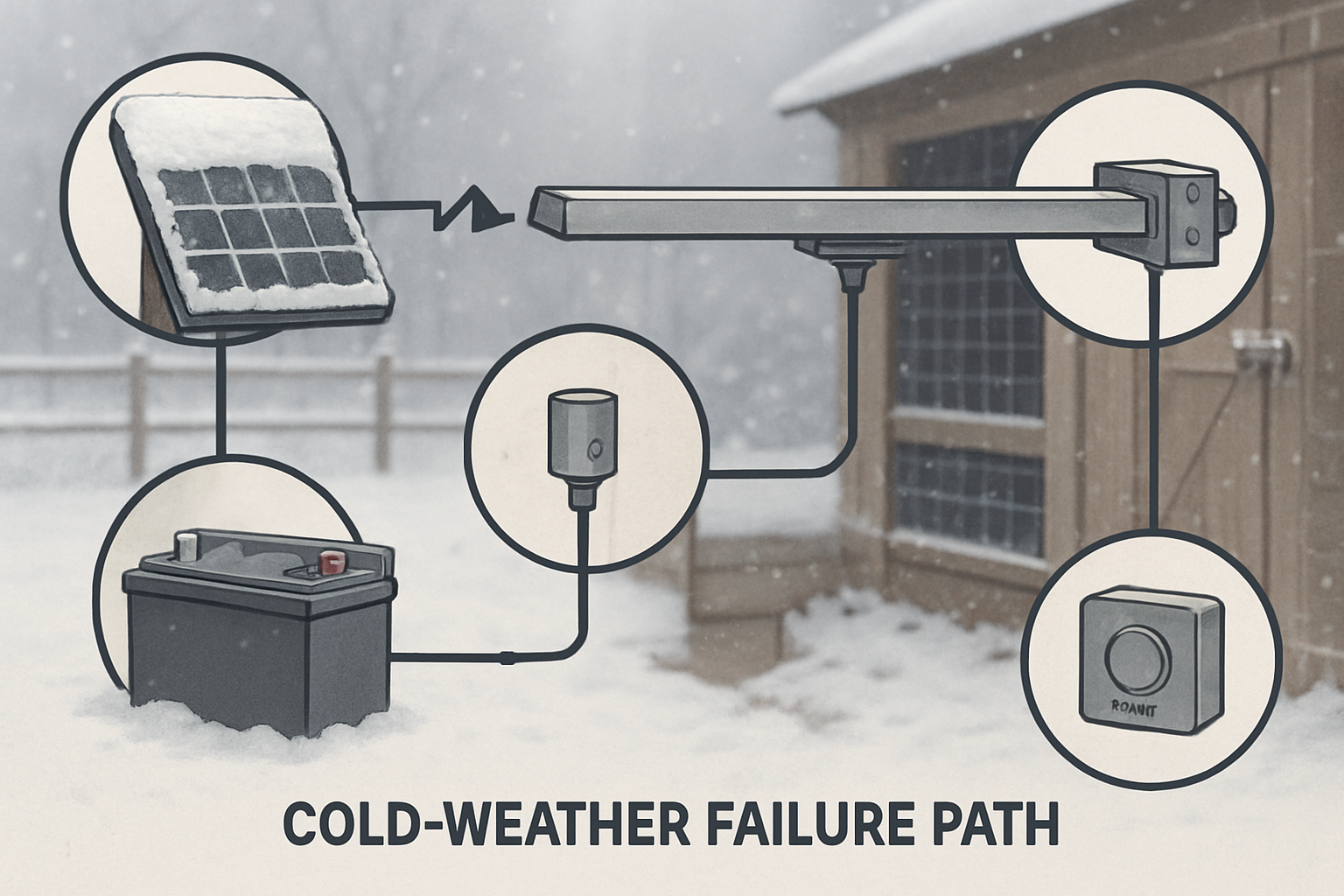
Automatic coop solar panels face severe efficiency drops in northern winters due to low sun angles, reduced daylight, and frequent cloud cover. Snow accumulation further obstructs panels, while battery performance declines significantly below 0°C (32°F), compromising system reliability when power is most needed.
Quick Diagnosis
In northern winters, automatic coop solar panels struggle due to minimal solar irradiance and battery inefficiencies. The sun's low angle and short daylight hours drastically reduce energy capture, while snow and ice further block panels. Batteries face chemical slowdowns below freezing, leading to unreliable power supply.
Technical Specification Snapshot
| Metric | Summer Performance | Winter Performance (Northern Latitudes) |
|---|---|---|
| Peak Sun Hours | 5–7 hours | 0.5–1.5 hours |
| Solar Irradiance | High (W/m^2) | Critically low due to atmospheric scattering |
| Albedo Effect Efficiency | N/A | +10% to +15% boost if ground snow is cleared |
| Battery Charge Acceptance | 100% efficiency | Near zero; drops completely below 0°C (32°F) |
Step-by-Step Troubleshooting
- Clear Snow and Ice: Regularly remove snow and ice from panels to maintain photon capture. Use a polyurethane ice scraper to avoid damaging the surface.
- Adjust Panel Angle: Tilt panels to Latitude + 15° to maximize sun exposure and facilitate snow shedding.
- Warm Battery Housing: Relocate batteries inside the coop to benefit from ambient warmth. This prevents freezing and maintains charge acceptance.
- Inspect Electrical Connections: Check for loose or corroded terminals. Apply dielectric silicone grease to protect against moisture.
- Monitor Voltage and Current: Use a multimeter to ensure the panel's output meets the motor's requirements. Swap in a warm backup battery if necessary.
Technical Disadvantages & Design Limitations
Automatic coop solar panels are not optimized for northern winters. Low sun angles and frequent snow reduce solar efficiency, while standard batteries lose capacity in cold conditions. Without modifications, such as internal battery placement and regular snow clearing, these systems are prone to failure.
Component-Level Diagnosis
- Solar Panels: Made from silicon crystal cells, these panels suffer from total light occlusion due to snow and frost, leading to voltage drops.
- Batteries: Typically LiFePO4 or Lithium-Ion, these batteries experience increased internal resistance in cold, reducing charge acceptance and triggering low-voltage cutoffs.
- Motor: Housed in 6061-T6 aluminum, the motor's gears can bind due to coagulated lubricants, increasing resistance and causing stall current spikes.
Amperage Deficit Equation
The current shortfall is calculated as:
Current deficit formula: I_deficit = I_motor – I_panel
Where:
- I_deficit is the total current shortfall.
- I_motor is the operational current needed (1.5 Amps).
- I_panel is the current supplied by the panel (0.05 Amps).
Material Science Insight
- Silicon Crystal Cells: These cells are sensitive to light occlusion, which can be caused by snow or frost. Regular maintenance is crucial to prevent voltage drops.
- LiFePO4 Batteries: Known for their stability, these batteries still face challenges in cold weather, where internal resistance increases significantly.
- 6061-T6 Aluminum: Used in motor housing, this material is durable but can suffer from lubricant coagulation in cold, affecting motor performance.
Prevention Checklist
- Panel Maintenance: Regularly clear snow and adjust angles.
- Battery Management: Keep batteries warm and swap regularly.
- Connection Checks: Tighten and protect terminals with grease.
- Load Management: Minimize unnecessary power draws.
FAQ
Can solar panels work in cloudy weather?
Yes, but efficiency is significantly reduced. Panels still capture diffuse light, but output is lower.
How often should I clear snow from panels?
Clear snow as soon as possible after accumulation to maintain efficiency.
What type of batteries are best for cold weather?
Low-temperature LiFePO4 batteries with internal heating are recommended for cold climates.
Sub-Zero Reset Protocol
When the system goes dark in mid-January, you need a systematic plan to revive it. Start by adjusting your structural angles; forcing your panels to a steep 60° or 65° tilt angle sheds winter snow loads naturally and aligns the silicon cells perfectly with the low-horizon sun. This adjustment maximizes the limited solar exposure available during the darkest months. Additionally, ensure that the panels are clear of any snow or ice that could obstruct sunlight, as even a thin layer can significantly reduce efficiency.
The real trick is managing the thermal environment of your storage cells. If you pull an umbilical wire from the outside panel to an interior battery box housed right over the birds' roosts, you use natural chicken body heat to keep ambient temperatures safely above freezing. This setup helps maintain battery efficiency and prolongs the life of your power storage. Stop expecting a small panel to keep up with daily motor spikes during the dark months of December and January. Implement a strict rotation by using the winter sun strictly as a weak trickle aid, and rely on a swap-ready secondary lithium pack kept indoors. Clear off any ice dams weekly, keep an eye on your voltage drops, and trim out any unnecessary power draws like indicator LEDs to preserve every milliamp.
Final Tactical Recommendation
To ensure your automatic coop door functions in northern winters, actively manage your energy resources. Tilt panels steeply, keep batteries warm inside the coop, and maintain a backup battery for quick swaps. Treat solar power as a supplemental source, not a primary one, to keep your system operational during the darkest months.